How to Conduct a Hazard Assessment: 5 Key Steps
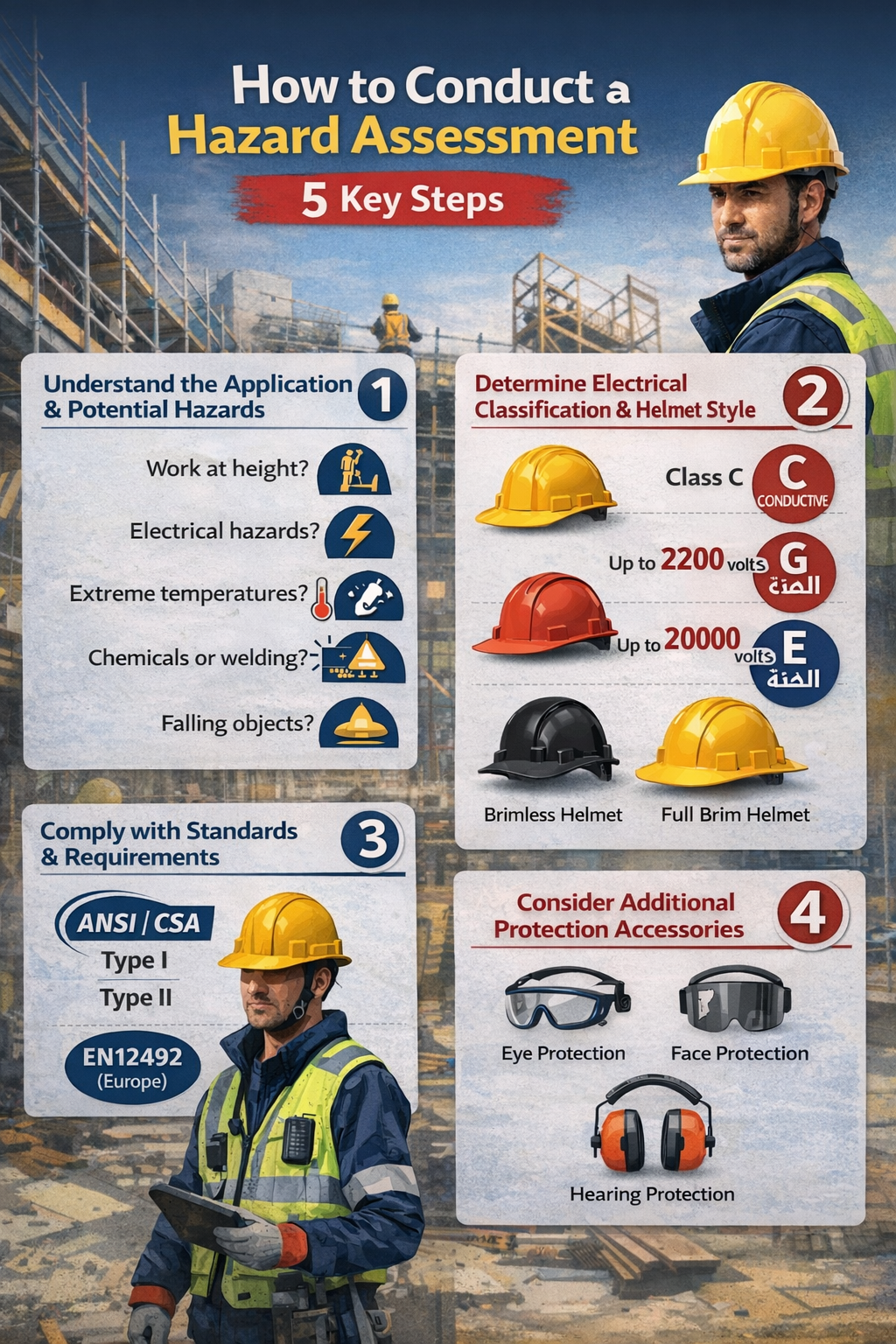
Here are five key steps you may want to include in your hazard assessment:
1. Understand the Application and Potential Hazards
The first is to fully understand the work environment and the specific risks workers may encounter. Ask questions such as:
Is the work being done at height or in a confined space?
Are there nearby electrical hazards?
Will workers be exposed to extreme temperatures or weather conditions?
Is there potential for chemical splashes or welding sparks?
What are the risks of falling objects or lateral impacts?
2. Determine Electrical Classification and Style
Based on the hazards identified, the next step is to determine the appropriate electrical classification and style of head protection:
Electrical Classification: Head Protection options fall within the following classes based on protection from electrical hazards:
Class C (Conductive – no electrical protection),
Class G (General – up to 2,200 volts), or
Class E (Electrical – up to 20,000 volts).
Remember that if workers require protection from electrical hazards, a non-vented hard hat or safety helmet is needed.
Helmet Style: Think about the work setting, along with worker preference in terms of look and style. Consider questions such as:
Do workers require brimless helmets for climbing or confined spaces?
Or is a full brim more beneficial for falling debris and/or sun protection during outdoor work?
3. Comply with Industry Standards and Requirements
Identify which standards apply for impact resistance and direction based on your region and industry. Currently, hard hats and safety helmets fall under either Type I or Type II based on ANSI and CSA standards:
ANSI/ISEA Z89.1 (U.S.) and CSA Z94.1 (Canada):
Type I: Designed to reduce force as a result of an impact to ONLY the top of the head.
Type II: Designed to reduce force as a result of an impact to the front, back, sides, and top of the head.
EN12492 (Europe): EN12492 may be relevant in climbing or technical rescue scenarios. Safety helmets certified to EN12492 (the mountaineering/climbing standard) feature a slightly expanded top impact-protection zone compared to traditional helmets. While EN12492-certified helmets offer additional top impact protection compared to ANSI Type I industrial helmets, they are not equivalent to ANSI Type II helmets, which are specifically designed to provide lateral (side) impact protection. Therefore, EN 12492 does not meet the same side-impact criteria as ANSI Type II standards.
Before choosing a hard hat or safety helmet, check that it meets the appropriate protection requirements for the application. If lateral protection is required, choose a Type II-certified helmet.
4. Consider Additional Head, Eye, Face, and Hearing Protection Accessories
Depending on the work environment and application, workers may require accessories.
We recommended you to subscribe to our newslatter, enter your email below to get daily update about us.

 Arabic