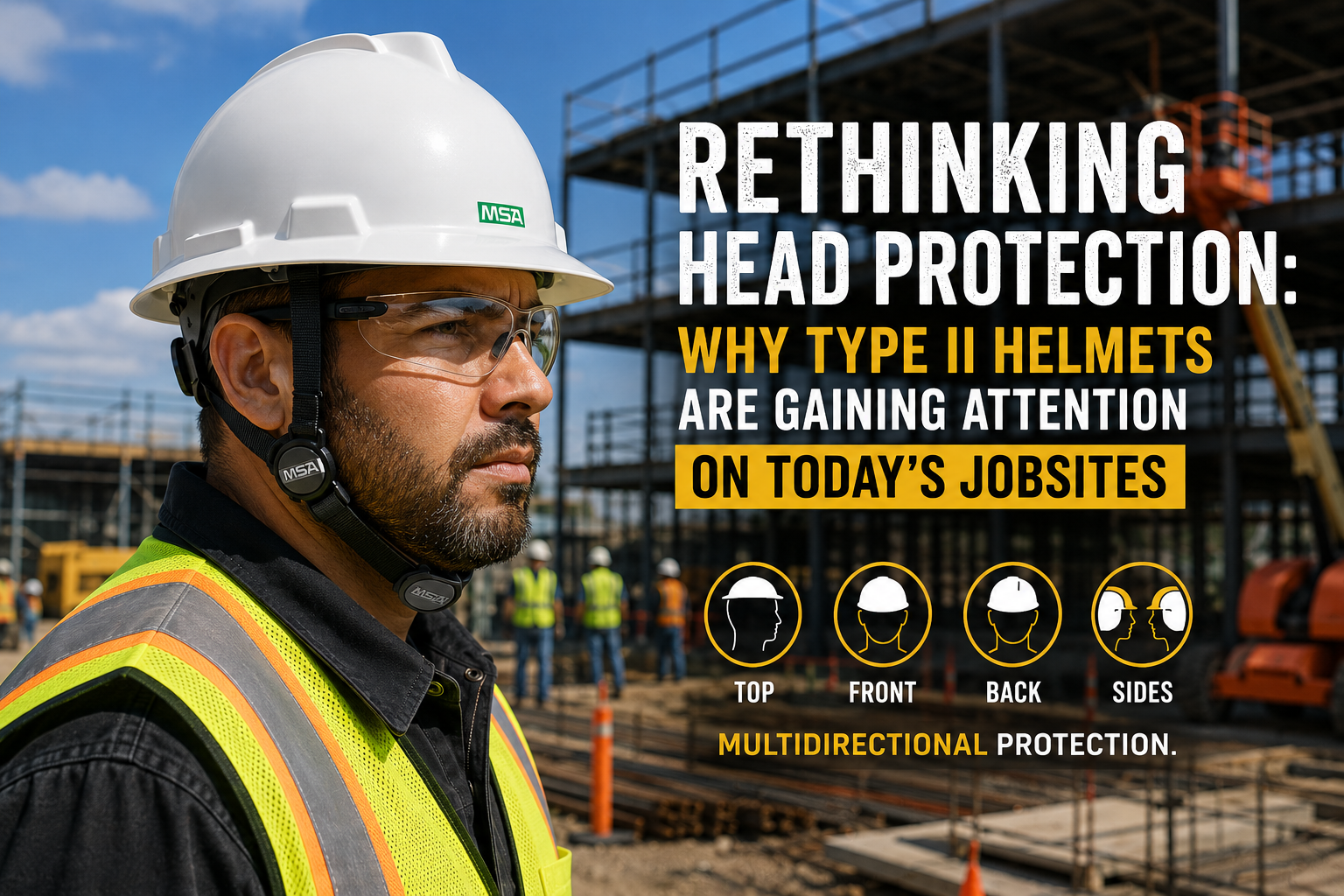
Rethinking Head Protection: Why Type II Helmets Are Gaining Attention on Today’s Jobsites
Traditional hard hats leave workers vulnerable to side impacts and falls, prompting safety managers to adopt advanced Type II head protection with internal liners and integrated chin straps.
For decades, the hard hat has been the universal symbol of construction safety. It has protected workers from falling tools, debris, and other overhead hazards. But today’s job sites look very different from those of the past. With more moving equipment, tighter work zones, elevated tasks, and complex site layouts, workers now face risks that traditional hard hats were never designed to address.
These evolving conditions are prompting safety professionals to re-evaluate whether existing head protection programs adequately address the full range of hazards workers encounter today. This article breaks down what they are, why they’re gaining traction, and how they support a more comprehensive, risk‑based approach to head protection.
How Jobsite Risks Have Changed
Traditional head protection standards were built around vertical hazards — objects falling from above. While those risks remain, data now show that many serious head injuries come from lateral or angled impacts. Workers may strike their heads on beams, formwork, equipment, or structural edges, or experience impacts during slips, trips, and falls.
Modern construction environments often include:
Mobile equipment congestion: forklifts, telehandlers, trucks, and loaders operating in tight spaces
Confined or enclosed work areas
Simultaneous work at multiple elevations
High foot traffic and material movement
These conditions create hazards from every direction, not just overhead, prompting many safety teams to reconsider whether traditional hard hats provide enough protection.
Type I vs. Type II Helmets: What’s the Difference?
In North America, industrial helmets follow the ANSI/ISEA Z89.1 standard. Helmets are classified by the direction of impact protection:
Type I helmets protect against top‑of‑head impacts only
Type II helmets protect against impacts to the top, front, back, and sides of the head
This distinction is significant. Type II helmets must pass additional tests for:
Lateral impact attenuation
Side-impact penetration resistance
These requirements do not apply to Type I helmets.
How Type II Helmets Address Multidirectional Hazards
The defining advantage of a Type II helmet is its ability to manage impacts from multiple angles. To achieve this, manufacturers typically use:
Reinforced shell designs
Internal energy‑absorbing liners
Suspension systems that distribute force around the head
Although chin straps are not required for Type II certification, many models include them to help keep the helmet secure during sudden movement or falls.
We recommended you to subscribe to our newslatter, enter your email below to get daily update about us.

 Arabic