Why Are Fire Pumps the Lifeline of Any Facility?
When we talk about fire protection systems in any residential building, commercial tower, hotel, or industrial factory, the first thing that comes to mind is Fire Pumps. They are not just machines that push water; they are the beating heart that pumps hope in the face of danger. In the Arab Republic of Egypt, with the massive urban and industrial expansion, relying on robust and efficient fire suppression systems is not a luxury but an absolute necessity to protect lives and property.
But have you ever wondered about the types of these pumps? How do they work together as one integrated system? And why do we constantly hear about the importance of international quality certifications such as UL and FM in the Egyptian market?
In this comprehensive guide, we will take you on a detailed tour to understand everything related to fire pumps, starting from their types and functions, all the way to the critical standards you must consider when selecting a fire protection system for your facility.
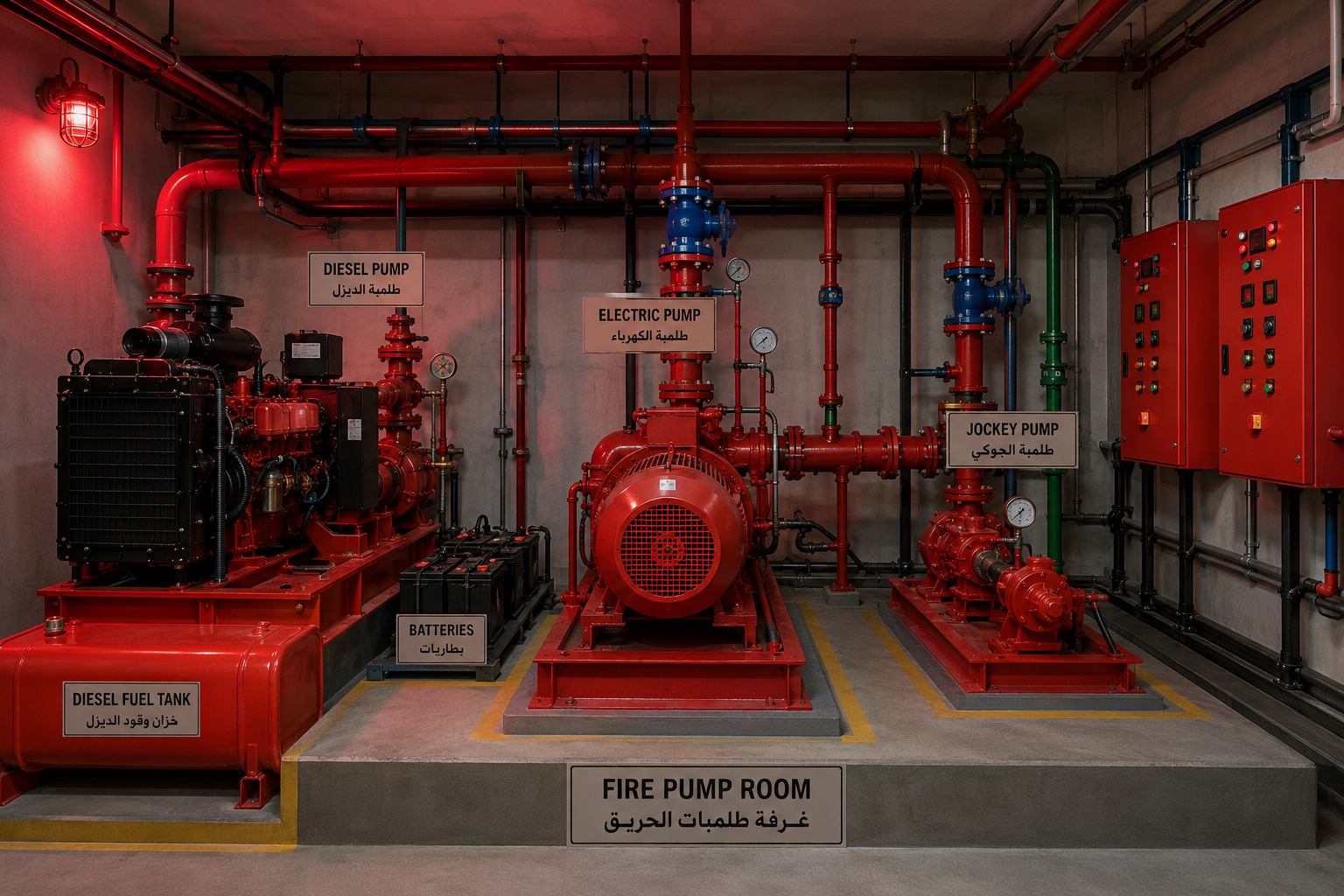
For a fire protection system to operate at peak efficiency, you cannot rely on just one type of pump. A standard, modern system typically consists of three primary types, working in harmony and integration to ensure water is delivered at the correct pressure and volume at the precise moment it is needed.
This is the primary and most commonly used pump in facilities, powered by electrical energy.
Primary Function: It is responsible for providing the design-required flow and pressure for the fire suppression system (whether sprinklers or fire hose cabinets) in the event of a fire.
Advantages:
High Operational Efficiency: Operates more efficiently compared to diesel engines under high loads.
Lower Maintenance: Has relatively fewer moving parts, and operating costs are lower as long as a stable electrical supply is available.
Quiet Operation: Does not generate excessive noise, making it ideal for residential and administrative buildings.
When to Choose It? It is the first and optimal choice for all projects where a stable electrical grid is available. It acts as the first line of defense.
This is the standby pump powered by a diesel engine, completely independent of the electrical grid.
Primary Function: Specifically designed to back up the electric pump in the event of a power outage, or if the electric pump fails for any reason. It starts automatically and takes over to maintain system continuity.
Advantages:
Total Independence: Operates entirely independently of the electrical grid thanks to its diesel engine and dedicated batteries, making it the only safe choice in areas prone to frequent power cuts.
High Reliability: Diesel engines are renowned for their durability and ability to operate under the harshest conditions.
Main Components: Consists of a diesel engine, a dual fuel tank, starting batteries, and a dedicated control panel that maintains battery charge and engine readiness.
This is the smallest pump in the group (often electric), yet its role is no less critical than the larger ones.
Primary Function: To maintain the fire protection system's pressure at the required level during normal, non-fire periods. It compensates for minor leaks in the piping or pressure fluctuations caused by temperature changes that affect water volume.
The Importance: Without the jockey pump, the large main pump would start and stop frequently to compensate for these minor leaks. This frequent cycling leads to:
Rapid wear and tear on the pump and motor components.
Higher electricity bills.
A significant reduction in the overall lifespan of the system.
To paint a clear picture, imagine this typical operation scenario:
Under normal conditions, the Jockey Pump operates silently to maintain the system pressure at, for example, 7 bar (approx. 100 psi).
If a minor leak occurs, the pressure drops to 6 bar. The pressure switch detects this drop, activates the Jockey Pump, restores the pressure to 7 bar, and then stops.
In the event of a fire, when fire hoses are opened or sprinklers activate, the pressure drops sharply below a set threshold (for instance, 5 bar).
Here comes the decisive moment: The pressure switch shifts to "start" mode, sending a direct signal to start the Electric Main Pump, which immediately begins pumping massive volumes of water to suppress the fire.
Simultaneously (or within seconds), the control panel also starts the Diesel Pump as a backup precaution. However, the Electric Pump remains the primary operator as long as power is available.
If the electrical power fails during the fire (a common scenario), the Electric Pump shuts down. At this critical point, the Diesel Pump takes full command of the situation and continues operating until the fire is extinguished or the fuel runs out (which the fuel tank is designed to prevent).
We recommended you to subscribe to our newslatter, enter your email below to get daily update about us.

 Arabic